Email API for Microsoft Outlook Integration

Unipile - Outlook Email API Hero (Light)
Outlook Email API

Connect & Sync Outlook 365 Mailboxes via API

Build powerful email features into your app using the Outlook Email API. Read, send, sync and react to Outlook and Microsoft 365 emails through a single REST interface backed by Microsoft Graph, without maintaining OAuth flows yourself.

outlook-sync.js
const response = await fetch( `https://${DSN}/api/v1/emails`, { headers: { 'X-API-KEY': apiKey, 'account_id': outlookAccountId } } ); const emails = await response.json(); // emails.items, array of Outlook messages // works for Outlook, Gmail & IMAP
200 OK, Outlook mailbox synced
Supports: Outlook Gmail IMAP
Definition

What is the Outlook Email API?

The Outlook Email API is a RESTful interface that gives developers programmatic access to Outlook and Microsoft 365 mailbox data. Built on top of Microsoft Graph, it lets your application read, send, organise and sync emails in any Outlook or Exchange Online account - using OAuth 2.0 for secure, user-delegated authentication. Developers integrate the Outlook Email API to build email clients, CRM sync engines, ATS tools, and outreach automation without exposing user credentials.

Underlying protocol
Microsoft Graph API (REST/JSON) - the single endpoint for all Microsoft 365 services including Outlook, Teams, and Calendar.
Auth model
OAuth 2.0 with Azure App Registration. Each linked account authenticates on behalf of its user - no shared credentials, no password storage.
Scope coverage
Personal Outlook accounts, Microsoft 365 Business, Exchange Online - all accessible through the same Outlook Email API endpoint.
Use Cases

Why Integrate the Outlook Email API into Your App?

Integrating the Outlook Email API into your application gives your users direct access to their Microsoft 365 mailbox inside your product, with no tab-switching and no manual copy-paste. Here are the four core capabilities that teams unlock most often.

Email Management
Integrate email communications seamlessly with your platform. Use Microsoft Graph to leverage powerful read, send, delete and folder operations, and ensure efficient synchronisation of all Outlook messages.
Workflow Automation
Send emails programmatically, trigger follow-up sequences on new messages, and automate routing rules. The Outlook Email API lets you eliminate manual work from every email-driven workflow in your app.
Real-Time Updates
Webhook subscriptions on Microsoft Graph push new-email events to your server the moment they arrive. No polling required, your app reacts in real time to every inbound Outlook message.
Enterprise Security
OAuth 2.0 with Azure AD ensures your app never stores user passwords. Microsoft's infrastructure handles token rotation, MFA, and conditional access, while Unipile wraps the whole flow in a white-label auth page.
Outlook API for CRM - Unipile
CRM Solutions

Microsoft Outlook API for Your CRM Solution

Sync Outlook conversations into sales pipelines and customer records

Outlook API for CRM
Scheduling and Pipeline Coordination
By syncing Outlook emails and calendars, your CRM enables seamless scheduling of sales meetings and follow-ups. Real-time webhook updates from Microsoft Graph remove the risk of missed appointments and slow pipelines.
Advanced Analytics and Engagement Insights
Integrating Outlook email data into your CRM unlocks deep customer-interaction analytics. Sales teams can track engagement rates, measure email effectiveness, and adapt outreach strategies based on real signals.
Automated Sales Workflows
With the Outlook Email API, your CRM can automate routine sales tasks such as follow-up emails, reminders and reply detection. Reps focus on high-value selling instead of repetitive inbox management.
ATS Editors

Sync Outlook Email for Applicant Tracking Systems

Microsoft Graph API for recruitment platforms and HR software

Outlook API for ATS
Streamlined Candidate Communication
Integrating the Microsoft Graph API lets your ATS sync Outlook emails directly inside the platform. Recruiters centralise every candidate conversation and stop switching between Outlook and your software.
Scheduling and Interview Coordination
By combining the Outlook Email API with calendar sync, your ATS offers seamless interview scheduling. Real-time webhook updates ensure no missed appointments and faster coordination with hiring managers.
Improved Data Security and Compliance
Microsoft Graph's OAuth 2.0 flow with Azure AD protects sensitive candidate data. Your ATS inherits enterprise-grade conditional access, MFA and audit trails, keeping recruitment compliant with GDPR.
Outreach Tools

Sync the Outlook API for Outreach Tools

Power multi-channel sales engagement platforms with Microsoft Graph

Integrating the Outlook Email API into your outreach software gives sales teams a single source of truth for every prospect interaction. Conversations stay in sync, follow-ups fire automatically, and engagement data feeds straight into your dashboards.

Seamless email and calendar sync across every prospect, with real-time webhook updates from Microsoft Graph so reps never miss a reply or meeting.
Advanced engagement analytics on open and reply signals, letting teams measure email effectiveness and refine sequences based on real performance data.
Automated follow-up sequences that pause on reply, branch on intent and route hot leads, all driven by Outlook events streamed through the Unipile API.
White-label OAuth flow via Azure AD, so your users connect their Outlook mailbox in seconds without ever leaving your outreach platform.
Outlook API for Outreach

Setting up Microsoft OAuth for the Outlook Email API

Microsoft OAuth Docs

By default, your integration uses Unipile's OAuth credentials. To get a full white-label experience when end users connect their Outlook or Microsoft 365 mailbox, register your own app in Microsoft Entra ID. Follow the 7 steps below to create the registration, configure permissions, and connect it to the Outlook Email API in your Unipile workspace.

1
2
3
4
5
6
7
01

Create a Microsoft Entra ID account

If you do not already have one, create a free Microsoft Entra ID account (formerly Azure Active Directory). This is the admin portal where you register the OAuth application that powers your Outlook Email API integration.

02

Register a new app in the Azure portal

Log in to portal.azure.com, open Microsoft Entra ID, and click New registration.

  • Name your app: this name appears on the Microsoft OAuth consent screen shown to your end users.
  • Supported account types: select "Accounts in any organizational directory (Any Microsoft Entra ID, Multitenant) and personal Microsoft accounts" so you can connect both business Microsoft 365 and personal Outlook mailboxes.
Open Microsoft Entra ID (Azure Active Directory) in the Azure portal
Register a new application in Microsoft Entra ID
03

Add redirect URIs

Open the Authentication panel and click Add URI under the Web section. Add 2 redirect URIs using your Unipile DSN (available in the Unipile Dashboard, top right corner):

https://{{YOUR_DSN}}/api/v1/hosted/microsoft_auth_request_callback
https://{{YOUR_DSN_less_port}}/api/v1/hosted/microsoft_auth_request_callback/port{{YOUR_PORT}}
04

Configure Microsoft Graph permissions

Go to API permissions > Add a permission > Microsoft Graph, then add the following Delegated permissions for the Outlook Email API:

Mail.Read
Mail.ReadWrite
Mail.Send

For Calendar features, also add Calendars.ReadWrite, Calendars.Read, Calendars.Read.Shared and Calendars.ReadWrite.Shared, then enable them in your Unipile Dashboard scopes settings.

Click Add a permission in the Microsoft Entra ID API permissions panel
Choose Microsoft Graph from the API permissions list
Add all required Delegated permissions for the Outlook Email API
05

Create a client secret

Open Certificates & secrets, click New client secret. Give the secret a description and set an expiration of 730 days (24 months), then click "Add".

Important: copy the secret value immediately. Microsoft only displays it once and you will not be able to retrieve it from this page later. Set a calendar reminder before the expiration date to avoid Outlook Email API downtime.
Create a new client secret in Certificates and secrets
Name the client secret and set an expiration date
Copy the client secret value before it is hidden
06

Connect your app to the Unipile Dashboard

Open the Unipile Dashboard and navigate to Settings > Microsoft OAuth.

  • Copy-paste the Application (Client) ID from the Azure Overview page.
  • Paste the secret value from the Certificates & secrets page.
  • Click Save.
You are now ready to connect Outlook and Microsoft 365 accounts through your own app. End users will see your branding on the OAuth consent screen instead of Unipile defaults.
Configure your Microsoft OAuth credentials inside the Unipile Dashboard
07

Test the connection

From the Unipile Dashboard, trigger a new Microsoft account link to verify that your custom OAuth credentials work end-to-end. You should see your app name and branding inside the Microsoft consent prompt instead of Unipile defaults.
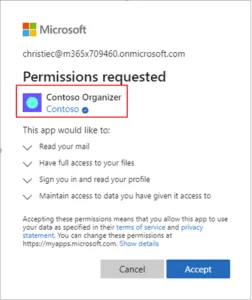
Microsoft OAuth consent prompt with your own app branding
Optional, for production apps
8
Become a verified publisher
Recommended for production - removes the "unverified" warning on the consent screen

With publisher verification, a blue checkmark appears in the OAuth consent prompt. Without it, business Microsoft 365 accounts may see an "unverified publisher" warning that hurts your sign-up conversion.

Step 1: join the Microsoft Partner Network

Step 2: verify your domain

Create a file named microsoft-identity-association.json and host it at:

https://yourdomain.com/.well-known/microsoft-identity-association.json

Step 3: link your Partner Global Account (PGA) ID

  • Find your PGA ID via Partner Center.
  • In the Azure Portal, go to App registrations > Your app > Branding & properties, enter the PGA ID and save.

For full details, see the Microsoft Publisher Verification documentation.

9
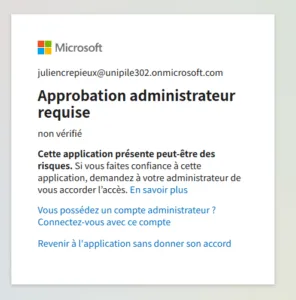
Handle "Administrator approval required"
When end users see a consent block from their Microsoft 365 admin

If an end user sees "Administrator approval required" when connecting their Outlook mailbox, the required consent has not been granted at the tenant level. Two paths to resolve it:

Method 1: admin consent request inside Microsoft Entra

A Microsoft 365 administrator reviews and approves the pending admin consent request. See the Microsoft documentation on reviewing admin consent requests.

Method 2: OAuth login as admin with tenant-wide consent

  • The admin starts the OAuth login flow from your app.
  • During Microsoft authorization, the admin must tick "Consent on behalf of your organization".
  • This grants consent for every user in the tenant and prevents the prompt for any future Outlook Email API connection.

Full details in the Microsoft consent troubleshooting guide.

Outlook Email API - Features
Features

Boost Productivity with Outlook Email API Features

Boost your users' productivity by leveraging Outlook Email API features, enabling seamless email management, automated workflows, and real-time synchronisation so they can focus on what truly matters.

Start New Email
Easily initiate new email messages through the Outlook Email API, automating the email creation process. Saves time by streamlining composition and reduces manual errors.
POST/api/v1/emails
POST /api/v1/emails
{
  "account_id": "acc_outlook_...",
  "to": [{"identifier": "lead@acme.com"}],
  "subject": "Quick intro",
  "body": "Hi {{first_name}}..."
}
List All Emails
Retrieve a comprehensive list of all Outlook messages, enabling efficient management and tracking. Provides a clear overview of communications and enhances organisation.
List and Get Folders
Access and manage Outlook email folders and labels, improving categorisation. Simplifies organising emails into folders and enhances the ability to locate specific messages quickly.
Inbox 248
Sent Items 86
Drafts 4
Deleted Items 12
Junk Email 3
Archive 1.2k
Webhook Notifications
Set up and manage webhooks to receive real-time Outlook email notifications. Ensures instant alerts for important email events and improves responsiveness and follow-up times.
webhook.received
// New email event delivered to your endpoint
{
  "event": "mail.received",
  "account_id": "acc_outlook_...",
  "email_id": "em_8FdK2...",
  "from": "sarah@acme.com",
  "timestamp": "2026-05-18T09:42:11Z"
}

Compare Outlook with Gmail and IMAP

Swipe to see more
Feature
Outlook
Gmail
IMAP
Hosted Auth
Custom Auth
OAuth
Credentials
Send / Reply Email
List Emails
Create Email Draft
Delete Email
Move Email
List Folders
Get Folder
New Email
Open & click tracking
Full Outlook Email API feature list
Start Building

Build your Outlook Email API integration today

Free trial included - no credit card required. Link your first Outlook account in under 5 minutes.

Build with Unipile - free
Code Samples

Outlook Email API Code Samples: Node.js, Python & cURL

The examples below call Unipile's unified Outlook Email API endpoint. One API key, one base URL - works for Outlook, Gmail, and IMAP without changing your code. Replace YOUR_DSN and YOUR_API_KEY with the values from your Unipile Dashboard.

Node.js
Python
cURL
read-outlook-emails.js
// Read emails from a linked Outlook account via Unipile Outlook Email API const axios = require('axios'); const DSN = 'api1.unipile.com:13211'; const API_KEY = 'YOUR_API_KEY'; const ACC_ID = 'OUTLOOK_ACCOUNT_ID'; // from POST /accounts after OAuth async function listOutlookEmails() { const res = await axios.get( `https://\${DSN}/api/v1/emails`, { headers: { 'X-API-KEY': API_KEY, 'account_id': ACC_ID } } ); console.log(res.data.items); // array of Outlook messages } // Send an email via Outlook Email API async function sendOutlookEmail() { await axios.post( `https://\${DSN}/api/v1/emails`, { account_id: ACC_ID, to: [{ display_name: 'Alice', identifier: 'alice@contoso.com' }], subject: 'Hello from Outlook Email API', body: '

Sent via Unipile Outlook Email API.

'
}, { headers: { 'X-API-KEY': API_KEY } } ); }
200 OK - emails retrieved from linked Outlook account
read_outlook_emails.py
# Read and send emails via Unipile Outlook Email API import requests DSN = "api1.unipile.com:13211" API_KEY = "YOUR_API_KEY" ACC_ID = "OUTLOOK_ACCOUNT_ID" HEADERS = { "X-API-KEY": API_KEY, "account_id": ACC_ID, } # List Outlook emails def list_emails(): r = requests.get( f"https://{DSN}/api/v1/emails", headers=HEADERS ) r.raise_for_status() return r.json()["items"] # Send via Outlook Email API def send_email(to_addr, subject, body): r = requests.post( f"https://{DSN}/api/v1/emails", headers={"X-API-KEY": API_KEY}, json={ "account_id": ACC_ID, "to": [{"identifier": to_addr}], "subject": subject, "body": body } ) r.raise_for_status() return r.json()
200 OK - Outlook messages returned as JSON list
outlook-email-api.sh
# List emails from linked Outlook account curl -s -X GET \ "https://api1.unipile.com:13211/api/v1/emails" \ -H "X-API-KEY: YOUR_API_KEY" \ -H "account_id: OUTLOOK_ACCOUNT_ID" \ | jq '.items[] | {id, subject, from, date}' # Send email via Outlook Email API curl -s -X POST \ "https://api1.unipile.com:13211/api/v1/emails" \ -H "X-API-KEY: YOUR_API_KEY" \ -H "Content-Type: application/json" \ -d '{ "account_id": "OUTLOOK_ACCOUNT_ID", "to": [{"identifier": "alice@contoso.com"}], "subject": "Hello from Outlook Email API", "body": "

Sent via Unipile.

"
}'
201 Created - email sent via Outlook
Same code for all providers: the Unipile Outlook Email API uses the exact same endpoint and payload structure as Gmail and IMAP. Your integration works across all 3 providers without code changes. See the Email API guide for the full endpoint reference.
Unipile - Outlook Graph vs Unipile
Build vs Buy

Native Microsoft Graph vs Unified Outlook Email API (Unipile)

Discover the clear advantages of leveraging Unipile's streamlined Outlook Email API integration compared to building directly on Microsoft Graph. Use Hosted Auth to bolster security through enhanced credential management, ensure smooth integration with Outlook and other email platforms, and reduce the overhead of maintaining OAuth flows.

Dimension Native Microsoft Graph API Unipile Outlook Email API
Integration scope Outlook / Exchange Online only Outlook + Gmail + IMAP, same code
OAuth flow setup Azure App Registration + token management per tenant One Hosted Auth link, white-label OAuth page, zero token code
Token refresh Your code must refresh every 60 min (access token lifetime) Unipile handles refresh automatically for all linked accounts
Webhook renewal Subscriptions expire at 4,230 min, you must renew before expiry Unipile renews Graph subscriptions automatically
Throttling handling Must implement 429 retry logic and exponential backoff manually Built-in retry and rate limit management
Time to first email 2-5 days (Azure setup + OAuth + token logic + error handling) Under 2 hours (follow this guide)
Exchange Online retirement Must migrate from EWS to Graph before October 2026 deadline Unipile already uses Graph, migration is transparent
Support Microsoft documentation + forums Live technical support + on-demand founder call
Native Microsoft Graph
Manual
1 Register app in Azure portal
2 Configure OAuth scopes and redirect URI
3 Build OAuth flow + token storage per tenant
4 Implement token refresh every 60 min
5 Handle 429 throttling and backoff
6 Renew webhook subscriptions before expiry
Unipile Outlook API
Automated
1 Generate a Hosted Auth link
2 User connects Outlook in one click
3 Receive emails via unified webhook
Tokens refreshed automatically
Built-in retry and rate limit handling
Webhooks renewed automatically

One Link Hosted Auth vs Full OAuth Flow

Unipile's Hosted Auth automates detection of email providers and handles authentication. This significantly lowers the complexity of the initial setup, accelerating development timelines and reducing maintenance. OAuth Email API guide

Consistent Updates and Maintenance

Stay ahead with regular updates and diligent maintenance. The Unipile Outlook Email API is continuously enhanced to track Microsoft Graph changes and deliver peak performance, so your integration works even when Microsoft updates its API. MS Graph integration guide

Our support team guides you through each phase of the Outlook Email API integration, from initiation to post-implementation, at no extra cost. Email API for developers

Watch Out

Common Pitfalls When Building with the Outlook Email API

The Microsoft Outlook API is powerful but has several non-obvious constraints that can break your integration in production. Here are the 6 most common pitfalls - and how to avoid them.

1
Access Token Expiry (60 minutes)
Microsoft Graph access tokens expire after exactly 1 hour. If your app caches the token and doesn't refresh it, API calls will start returning 401 errors in production - often only after the first real user session.
Fix: always use the refresh_token with offline_access scope. Check token expiry before every call and refresh proactively. With Unipile, token refresh is handled automatically for all linked accounts.
2
Webhook Subscription Expiry (4,230 minutes)
Microsoft Graph subscriptions for Outlook mail events have a maximum lifetime of 4,230 minutes (~70.5 hours). After that, no new-email webhooks are delivered and you won't receive an error - events just silently stop.
Fix: implement a subscription renewal job that runs every 48 hours. Call the PATCH /subscriptions endpoint with a new expirationDateTime before the current one expires.
3
Throttling (429 errors under load)
Microsoft Graph enforces per-app throttling limits - approximately 10,000 requests per 10 minutes per tenant. Multi-user apps that fan out requests during peak load will hit 429 Too Many Requests errors without warning.
Fix: implement exponential backoff with jitter on every API call. Respect the Retry-After header in 429 responses. Consider batching requests using Graph's $batch endpoint.
4
Admin Consent Flow for Enterprise Tenants
Enterprise Microsoft 365 tenants often require tenant admin consent before any user in the organisation can grant your app permission. If you only test with personal Outlook accounts, this problem won't surface until you reach enterprise customers.
Fix: implement the admin consent flow (/adminconsent endpoint) and display a clear error message to users who hit consent errors. Document the admin consent URL in your onboarding flow. MS Graph OAuth guide
5
Exchange Web Services (EWS) Retirement
Microsoft is retiring Exchange Web Services (EWS) for Exchange Online in October 2026. Any integration still using EWS (a common legacy approach) will break. This affects on-premise Exchange migrations to Exchange Online as well.
Fix: if your integration or any dependency uses EWS, migrate to Microsoft Graph before October 2026. Unipile's Outlook Email API already uses Graph exclusively - no action needed on your end.
6
Basic Authentication Deprecation
Microsoft has fully deprecated Basic Authentication for Exchange Online across all protocols (SMTP, IMAP, POP). Any code using username/password to authenticate directly to Outlook will fail. This commonly breaks legacy email sync implementations.
Fix: migrate to OAuth 2.0 (client credentials or delegated permission flow). Use Unipile's custom auth only for IMAP servers that still support it - the Outlook Email API integration must always use OAuth. OAuth Email API guide
EWS Retirement Deadline: October 2026

Exchange Web Services for Exchange Online will stop working in October 2026. If your Outlook Email API integration uses EWS directly or via a library, plan your migration to Microsoft Graph now. See the Microsoft Graph API guide for the migration path.

Security & Compliance

Security & Compliance for Outlook Email API Integrations

Ensure the security of your data with advanced security protocols. The Unipile Outlook Email API guarantees that your emails and sensitive information remain protected - with SOC 2 Type II certification and full GDPR compliance.

SOC 2 Type II Certified
GDPR Compliant
OAuth 2.0 Only
No credential storage
Data Handling
No parallel email storage
Unipile acts as an authenticated intermediary on behalf of each user. Email data is not stored in a parallel database or archive. The scope is limited to the authenticated session of each linked account.
How Unipile Operates
Independent technical intermediary
Unipile is an independent technical intermediary acting on behalf of each authenticated user. It is not a Microsoft partner. Credentials are never shared across accounts.
Platform Limits
Responsible use of Outlook API
Microsoft Graph rate limits and throttling are relayed transparently. Cadence and volume of API calls remain a customer-side decision. Unipile surfaces limits but does not override Microsoft's enforcement policies.
Build your secure Outlook Email API integration
Unipile - Outlook Email API FAQ
FAQ

Frequently Asked Questions

Answers to the most common questions about the Outlook Email API, Microsoft Outlook API, and Outlook 365 API integration with Unipile.

01
What is the Outlook Email API and how does it work?
The Outlook Email API is a RESTful API that provides programmatic access to Outlook email data. It is built on Microsoft Graph, the unified API gateway for Microsoft 365. When you call the Outlook Email API, your request goes to graph.microsoft.com/v1.0/me/messages, authenticated with an Azure AD OAuth 2.0 bearer token. Unipile wraps this into a simple, provider-agnostic interface that also works for Gmail and IMAP.
02
What is the difference between the Outlook 365 API and the Outlook Web API?
The Outlook 365 API typically refers to accessing Microsoft 365 Business or Enterprise mailboxes via Microsoft Graph. The "Outlook Web API" is an older term for a REST API that Microsoft retired and replaced with Microsoft Graph. Today, any modern Outlook Email API integration should use Microsoft Graph. Both personal Outlook accounts and Microsoft 365 Business accounts are accessible through the same endpoint.
03
How is the Microsoft Outlook API different from Exchange Web Services (EWS)?
Exchange Web Services (EWS) is a legacy SOAP-based API that Microsoft is retiring for Exchange Online in October 2026. The modern Microsoft Outlook API uses Microsoft Graph (REST/JSON) instead. If you're building a new integration or migrating a legacy one, use Microsoft Graph via the Outlook Email API. EWS will stop working for Exchange Online after the retirement date. See our Microsoft Graph API guide for the migration path.
04
How do I authenticate users with the Outlook Email API?
Authentication for the Outlook Mail API uses OAuth 2.0 with Azure AD. You need to: (1) create an Azure App Registration, (2) add the Mail.ReadWrite, Mail.Send and Mail.Read delegated permissions, (3) implement the authorization code flow to get an access token. With Unipile, you skip all of this. Use Hosted Auth to generate a one-link OAuth page for your users. See the full OAuth Email API guide and the Microsoft Graph OAuth guide.
05
Can I use the Outlook API to read emails, not just send them?
Yes. The Outlook Email API supports both reading and sending emails, as well as organising them. Operations include: list all messages, get a specific message, send a new message, reply, forward, delete, move to folder, mark as read, and list folder contents. See the Read Email API guide and Send Email API guide for specific endpoint documentation.
06
Does the Outlook Email API work for both personal Outlook accounts and Microsoft 365 Business?
Yes. Microsoft Graph supports both personal Microsoft accounts (outlook.com, hotmail.com, live.com) and Microsoft 365 Business accounts (Exchange Online). The Outlook Email API endpoint is the same for both. You need to set your Azure App Registration's audience to "Accounts in any organizational directory and personal Microsoft accounts" to support both types.
07
Why should I integrate the Outlook Email API into my application?
Integrating the Outlook Email API streamlines email management, enables workflow automation, and enhances your product with real-time inbox access. Key benefits: automate routine email tasks, build email-native features without switching apps, and sync Outlook data directly into CRM, ATS or outreach platforms. The Outlook API accelerates workflow by reducing manual effort and boosts deliverability by using Microsoft's infrastructure. See the full Email API guide for the complete picture.
08
Can I integrate Gmail and IMAP alongside Outlook with Unipile?
Yes. Besides the Outlook Email API, Unipile supports Gmail and IMAP, the three major email providers. The same API endpoint and payload structure work for all three providers. Your integration works across Outlook, Gmail, and IMAP without code changes. See the Gmail API guide and IMAP API guide.
09
Is there a free tier to test the Outlook Email API with Unipile?
Yes. Unipile offers a free trial that lets you link Outlook accounts and make Outlook Email API calls without a credit card. See the Free Email API guide for the trial limits and getting started steps, or sign up directly on the dashboard.
Still have questions? Our team is here to help you integrate the Outlook Email API into your product.
Talk to an expert

You may also like

Retrieve Emails with Unipile API

Retrieve Emails with Unipile API

Managing and retrieving emails programmatically is a critical skill. Whether for business automation, customer support, or marketing purposes, understanding how to use an Email API to retrieve emails can streamline operations and improve efficiency. This guide will walk you through the essentials...

read more
How to Get Email API for Your Software

How to Get Email API for Your Software

Explore the advantages of integrating an API, as it presents a gateway to unlocking numerous benefits in seamlessly incorporating multiple email services into your application.What is an Email API?An Email API (Application Programming Interface) is a service that allows developers to integrate...

read more
Google OAuth Verification & Gmail API Credentials (2026)

Google OAuth Verification & Gmail API Credentials (2026)

Gmail API Unverified App Warning The "This app isn't verified" warning, the 100-user cap & exemptions Before your app passes Google OAuth app verification, every user who tries to authorize it sees a warning screen. Google also enforces a hard 100-user limit on unverified external apps. Here is...

read more
en_USEN